How IT Asset Management Software Features Integrate with CMDB and ITSM
There’s now enough variety in IT asset management (ITAM) platform capabilities that it’s difficult to know where vendor solutions actually fall on the maturity spectrum. Some platforms automate discovery, reconcile purchases with deployments, and enforce lifecycle policies. Others amount to databases with custom fields where IT teams manually record what they already know from spreadsheets.
The gap with platform capability matters. For context, a platform at “basic” maturity for license normalization might identify 20% of your asset inventory accurately, while “advanced” platforms reach 95%. And, of course, platform vendors rarely quantify where they fall on this spectrum during demos.
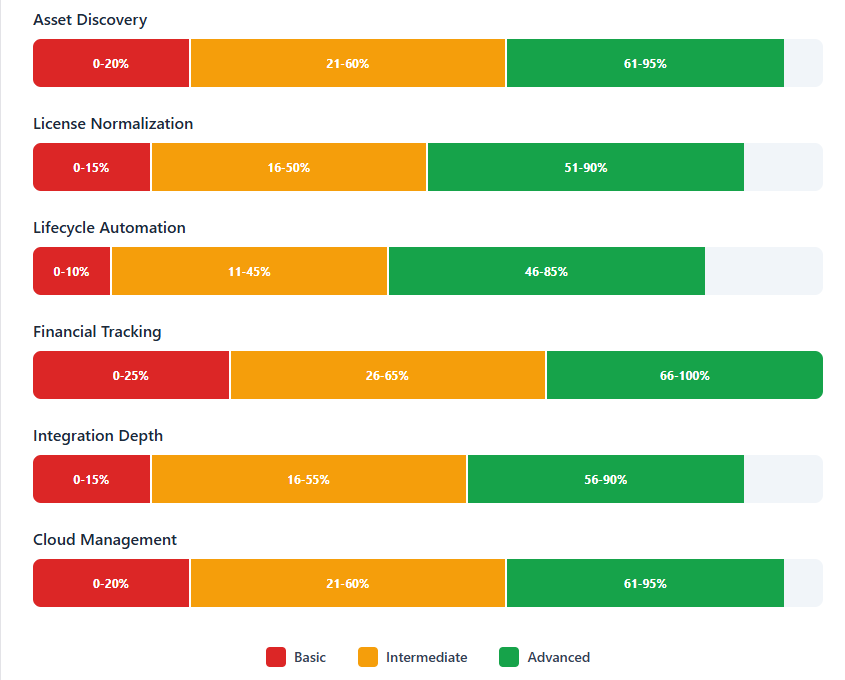
Capability depth varies dramatically across ITAM vendor solutions
Surprisingly, most enterprise leaders are misinformed about what their system should actually offer and what the real challenges are that their enterprise deals with. If the data describing your assets is incomplete or inaccurate, every downstream ITSM process will fail. An ITAM tool is the engine that drives this essential data quality, and hence, the choice of features you seek in an ITAM tool basically defines the operational ceiling for your asset governance program.
In this article, we discuss a practical framework for evaluating ITAM platforms based on what capabilities they should actually deliver and why those features matter.
Summary of essential ITAM software features
| Feature | Purpose |
|---|---|
| Hybrid discovery and centralized inventory control | Provides a single query point to obtain complete, accurate, and trustworthy asset information across all environments through both automated and manual discovery methods. |
| Complete attribute capture and asset dependency tracking | Automatically maps relationships among assets to identify what connects to what, what depends on what, and what breaks if something fails. |
| Service mapping and topology visualization | Presents dynamic topology maps showing infrastructure connections to support impact analysis, blast radius assessment, and controlled deployment planning. |
| Software license normalization | Consolidates software variations into canonical records that recognize products regardless of how they appear across different systems. |
| Hardware asset correlation and lifecycle management | Tracks hardware assets and their costs throughout the lifecycle from purchase to disposal. |
| Network and IP correlation | Tracks IP assignments at the subnet and VLAN levels, correlating them with discovered hardware to trace issues from software to server to network connection. |
| Cloud cost tracking and TCO calculation | Ingests billing data from cloud provider APIs to attribute cumulative spend and provide total cost of ownership metrics comparable to physical assets. |

Hybrid discovery and centralized inventory control
According to ITIL 4, one of the main objectives of the ITAM practice is ensuring that information about IT assets and related entities—such as contracts and vendors—is trustworthy, accurate, complete, and available when it’s needed. When evaluating platforms, look for features that facilitate automatic IT asset discovery, both agent-based and agentless. Make sure that the platform also accommodates the manual entry of non-discoverable IT assets such as legacy systems with proprietary protocols or devices that are off-network or in isolated network segments.
Also assess how well the platform can ensure accuracy and completeness metrics rather than just discovery coverage. The goal is a unified CMDB where a single query retrieves the complete asset picture across all environments, eliminating the need to check multiple systems.
The following illustration shows the scope of comprehensive discovery in inventory management, including macro details and attributes of assets.
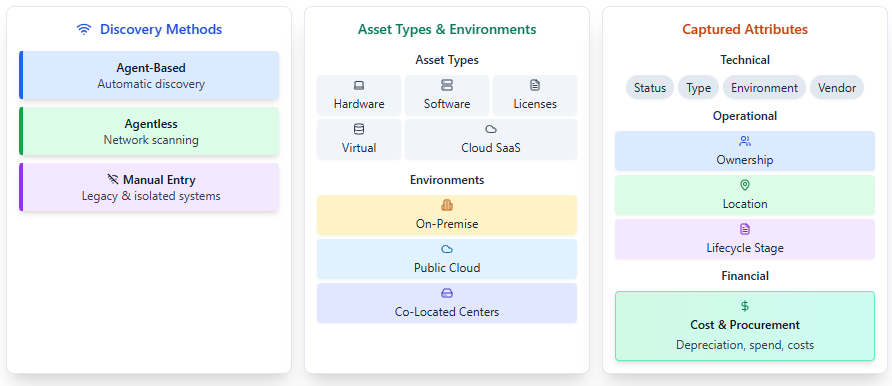
Multi-method discovery and complete attribute capture from inception
Previously, organizations could only maintain basic spreadsheets that captured simple attributes like asset name and purchase date. However, those spreadsheets don’t tell you many different things, such as whether licenses are overprovisioned or whether assets are nearing end of life.
As illustrated above, with modern ITAM platforms, you can define discovery requirements, and the software can accommodate them. That means your IT teams don’t have to tolerate gaps in virtual asset tracking or even cloud service visibility. Instead, they get autopopulated inventory records and dashboards that visualize current and historical IT asset data. Some ITAM platforms also offer out-of-the-box features that facilitate the tagging of hardware assets to enhance visibility and control.
Configuration item (CI) and asset dependency tracking
Once assets across your environment are discovered and inventoried, the relationships among them should be mapped. When discovery runs and inventory updates, your ITAM platform should automatically map how assets connect, which components depend on others, and which services break if something fails.
The difference between basic and advanced relationship mapping shows up in usage patterns. The information gained is valuable since it enables IT teams to pinpoint the sources of issues or highlight critical elements that must be managed carefully during upgrades/migrations or other IT service management activities (such as change impact analysis, incident root cause analysis, etc.).
Service mapping is achieved through automated service configuration models that visualize relationships discovered between IT assets. The relationship data in such cases is presented through dynamic topology maps that show how assets connect across your infrastructure. It can quickly help you assess impact analysis capabilities, including blast radius assessment, risk scoring, and controlled deployment planning.
Consider an example where an organization is planning a database migration. The dependency map needs to not only show which applications connect to that database but also reveal if the migration will cascade to downstream services that support critical business functions.
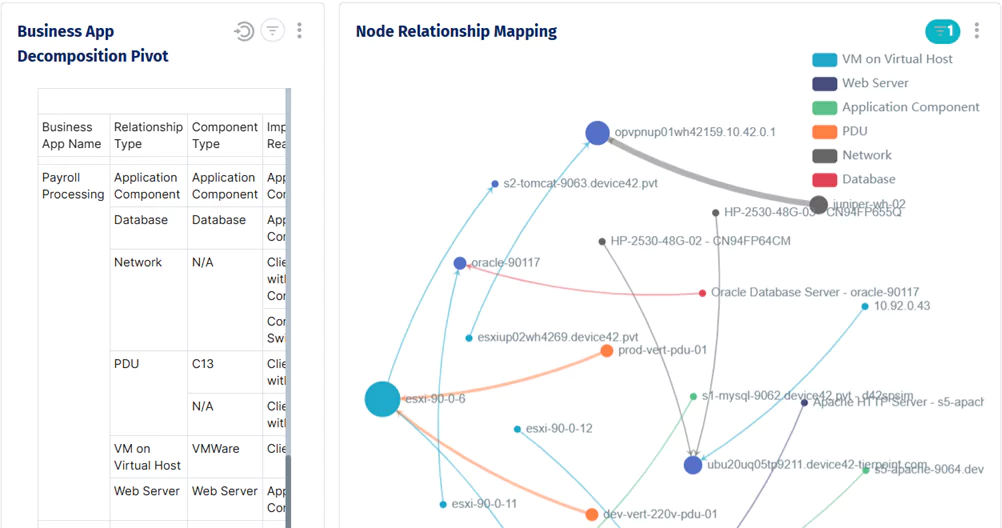
Device42 discovers physical as well as logical dependencies and brings them together in interactive dashboards.
Modern ITAM platforms come with common relationship types built in, such as software-to-hardware, application-to-database, and license-to-instance. Look for platforms that allow you to define custom mappings of CI interdependencies beyond these defaults. Your infrastructure likely has unique dependencies (for instance, containerized applications tied to orchestration platforms, SaaS subscriptions linked to identity providers, or IoT devices connected to edge gateways) that generic relationship models won’t capture. The platform should enable you to model these without requiring extensive customization or specialized boutique services.
Software license normalization and categorization
It’s not practical for every organization to manually track licenses across every system. This may be because their legacy systems weren’t fundamentally designed for integrated license management (making it hard to change) or due to the sheer volume of software installations not being conducive to manual tracking.
Adopt platforms that automatically track software deployments during discovery, match them to license entitlements in real time, and flag compliance gaps before they become audit findings. Another key point to consider is the ITAM tool’s ability to normalize discovered software into manageable components.
Consider a common scenario where discovery scans find “Adobe Acrobat Reader DC 2024.001.20643” on one machine, “Adobe Reader DC” on another, and “Acrobat Reader 2024” on the third. To prevent redundant records, the platform should be able to normalize raw discovered data into a software library that recognizes products regardless of how they appear across different systems. Typically, the normalization engine matches publisher information and consolidates variations into canonical component records. Administrators can approve the suggested mapping or create a new component definition, and from that point forward, any new discoveries of that software variation automatically link to the canonical component without needing manual intervention.
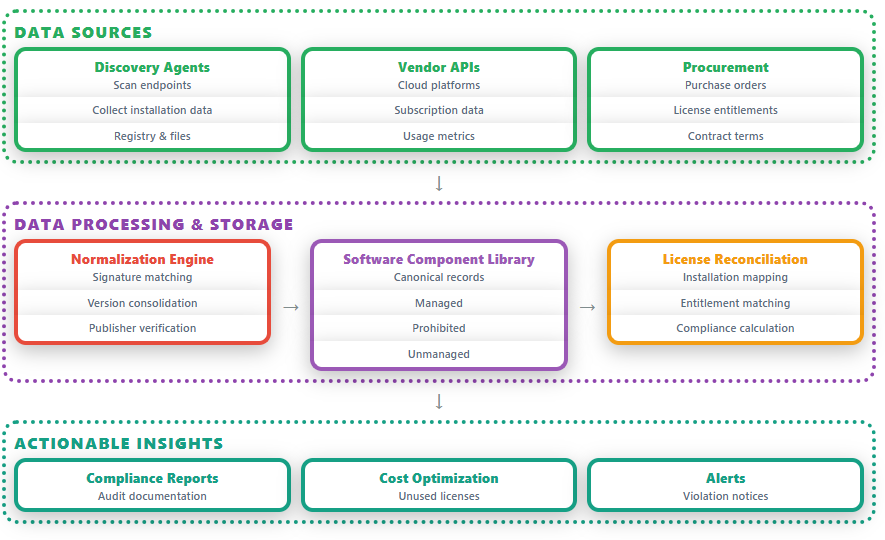
ITAM license management data flow
The platform must also support software categorization that determines which components require active license tracking. Your team would likely need to distinguish among:
- Managed software that requires rigorous license compliance tracking and enforcement
- Prohibited software that violates policy and triggers immediate alerts
- Unmanaged software that exists without formal IT oversight
- Mandated software that must be present on certain systems (e.g., security patches, endpoint protection), with exceptions automatically flagged for remediation
In addition, if your environment includes perpetual licenses, subscriptions, consumption-based pricing, and hybrid models, consider the support of multiple license models without requiring custom configuration.
Given that software type is one of the core CIs of any ITAM practice, learn how Device42 offers you different ways to track software components by their licensing models.
Multi-method asset discovery and inventory consolidation
Hardware assets follow their own lifecycle from procurement through disposal, and each stage generates operational dependencies that require systematic tracking.
Look for ITAM platforms that automatically map dependencies by correlating data across different discovery scans. Hardware assets should be automatically matched using a hierarchy of identifiers, typically in the following order:
- Serial number as the primary key
- MAC addresses for network devices
- Fuzzy matching on manufacturer, model, and location combinations when unique identifiers aren’t available
When application discovery finds software installed on a server, and infrastructure discovery identifies that server’s hardware details, the system should create relationship records linking hardware assets to application components, users, locations, and network infrastructure (including IP addresses). The platform should track IP assignments at the subnet and VLAN levels, correlating them with discovered hardware and mapping switch port connections. Organizations sometimes undervalue this during evaluation, concentrating on discovery coverage percentages, but IP correlation determines whether you can trace an application issue from the software component to the server to its network connection within one system. The correlation logic should also handle edge cases like virtual machines with dynamically generated UUIDs and devices behind NAT where IP addresses aren’t reliable.
Following asset discovery, evaluate whether the platform implements the asset lifecycle as a finite state machine with defined valid transitions. This means that assets should move only through defined stages, and each transition should trigger configurable workflow actions such as:
- Assigning assets to users and updating locations when moving to “deployed”
- Generating procurement notifications when approaching warranty expiration
- Automatically populating replacement planning reports when assets reach end of life based on your refresh policies
As for cloud assets, managing them requires a different approach because they’re ephemeral and software-defined. The ITAM platform should first be able to integrate with your cloud provider APIs to continuously sync resource inventories. Unlike physical hardware with stable serial numbers, cloud resources have identifiers that only exist while the resource is running. For example, if someone terminates an EC2 instance and later launches a new one, it gets a new instance ID.
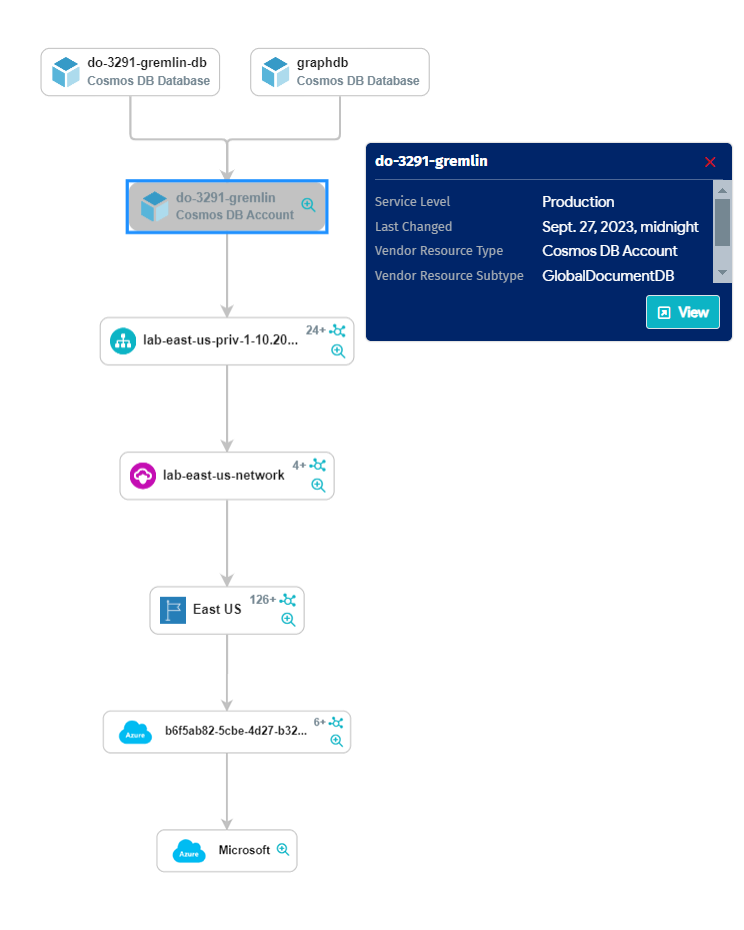
Autodiscovery of cloud instances and resources with Device42
Unlike the identifiers (serially listed above) used for “hard assets,” the platform typically correlates cloud resources using tags that your organization applies. A resource can be tagged as a cost center, an application owner, or an environment (prod/dev/test). When discovery runs, the agent matches resources by tag and updates existing records or creates new ones. The critical difference is that cloud asset “retirement” happens automatically when someone terminates a resource. Platforms detect this either by monitoring cloud provider deletion events via API polling or event subscriptions (like AWS CloudWatch Events), or more commonly through automated logicset rules that transition any cloud resource to disposed status if it hasn’t been detected during discovery for a configured number of days.
Cloud cost tracking also requires a different implementation than depreciation, as there’s no upfront capital cost to depreciate. Instead, the platform should be designed to ingest billing data from cloud provider cost APIs, aggregate it by resource ID, and attribute cumulative spend to each cloud asset record. Eventually, you get a total cost of ownership (TCO) metric comparable to physical assets, though the calculation method is fundamentally different (accumulated operating expense vs. depreciation of capital expense).


Fastest time to value with easy implementation and agentless asset discovery
Comprehensive hardware and software inventory management

Broadest discovery from legacy technology to the latest cloud and containers
Last thoughts
Before comparing ITAM tools, you need to be sure about what problems you are looking to solve. Are you facing audit exposure because you can’t maintain license compliance? Are you hemorrhaging budget on unused software subscriptions? Clarity about desired outcomes will help you evaluate whether the tool’s capabilities actually address your problems or if there are process-level changes that must be dealt with first.
For context, automated discovery matters if you’re struggling with incomplete asset visibility but not if your real problem is that discovered assets sit unassigned because nobody owns the reconciliation process. The same logic applies to every feature discussed in this guide.
Ready to see ITAM capabilities that really matter? Start a free trial of Device42 to see why the platform is trusted by leading organizations in over 60 countries.